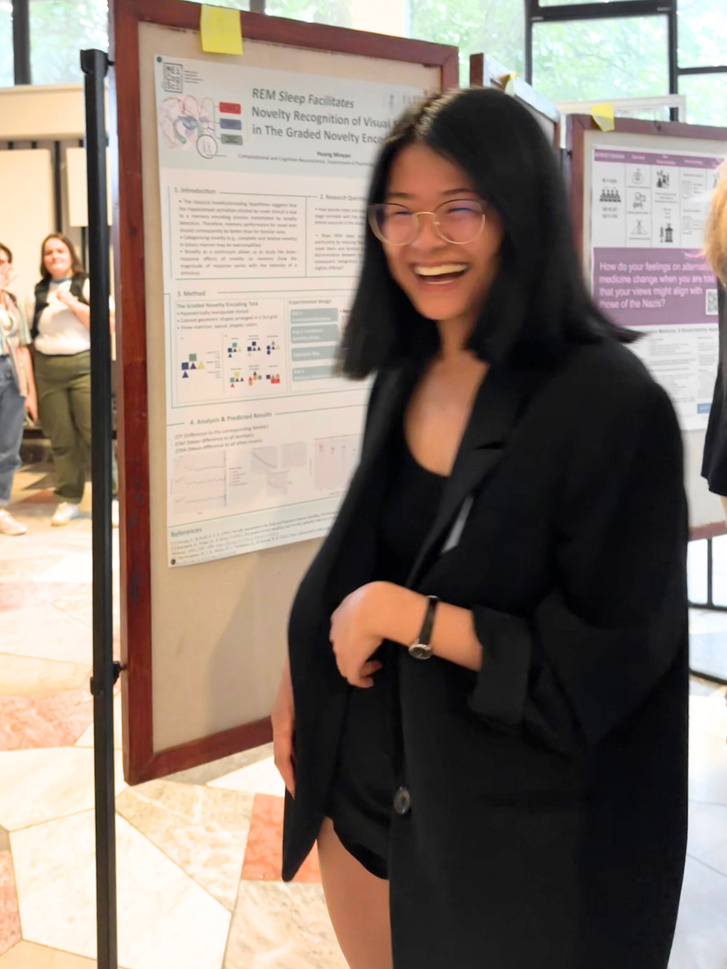
Minyan Huang investigates how brain stimulation reaches its intended targets and influences connected brain regions. In the Tik Group at the Medical University of Vienna, she combines interleaved TMS-fMRI with the study of orbitofrontal and frontolimbic circuits relevant to depression.
She plays a substantial role in piloting the group’s experiments, from preparing individual stimulation targets and testing protocols to acquiring and analysing imaging data. Her work also contributes to the practical implementation of EPICONN and chronometric TMS-fMRI.
Research and methods
Minyan’s orbitofrontal research uses stimulation during fMRI to examine local target engagement and responses across connected cortical and subcortical regions. This work asks how the choice of stimulation site changes the networks engaged by TMS.
Alongside these experiments, she develops MATLAB analysis workflows, works with single-echo and multi-echo resting-state fMRI, and helps optimise interleaved acquisition protocols. She evaluates signal-to-noise ratio and parallel-imaging noise amplification across imaging and stimulation configurations. Her methodological toolkit includes SPM, FSL, SimNIBS, MATLAB, Python and R.
Background
Minyan began her PhD at the Medical University of Vienna in October 2025, supervised by Martin Tik. She first joined Martin’s research through her master’s thesis in December 2024, followed by an OeAD-supported research internship in 2025.
She holds an MSc in Computational and Cognitive Neuroscience from the MEi:CogSci joint programme at the University of Vienna and Eötvös Loránd University (2025), and a BA in Psychology from Eötvös Loránd University (2023). Her earlier projects explored sleep and memory, visual perception, and brain–computer interfaces.
Publications and conference contributions
Post Hoc Localization of Beam F3 Stimulation Targets: An MRI-Derived Geodesic Approach for Refined TMS E-Field Simulations
Schramm S, Ten Pas J, Calabrò D, Jakubetz J, Szillat M, Koti J, Huang M, Kim SH, Woletz M, Kirschke J, Hedderich DM, Sollmann N, Tik M, Vogelmann U.
Orbitofrontal TMS Engages Fronto-limbic Circuits Relevant to Depression: Evidence from interleaved TMS-fMRI
Huang M, Woletz M, Schramm S, Vasileiadi M, Soanca O, Schuler A-L, Downar J, Tik M.
Interleaved TMS-fMRI Demonstrates Target Engagement in the Orbitofrontal Cortex
Huang M. Proceedings of the MEi:CogSci Conference, 19.
REM Sleep Facilitates Novelty Recognition of Visual Stimuli
Huang M. Proceedings of the MEi:CogSci Conference, 18.
Master’s thesis
Novel Orbitofrontal Cortex Stimulation Targets Engage Cortico-Striatal Loop Circuits: An Interleaved TMS-fMRI Study
Research carried out at the Medical University of Vienna under the supervision of Martin Tik, supported by Erasmus and CEEPUS scholarships.
Presentations and recognition
Minyan received a Poster Presentation Award at the 20th YSA PhD Symposium in 2025 for her orbitofrontal TMS-fMRI work. She also presented at the MEi:CogSci conferences in Bratislava (2024) and Ljubljana (2025), and contributed a poster to the 2nd Workshop on MRI of Neuromodulation in Vienna (2026).