Neuroimaging-informed
brain stimulation.
We combine brain imaging with precisely timed stimulation to understand how human brain networks respond — and to inform more personalised approaches to neuromodulation.
TMS-fMRI research in Vienna.
Led by Martin Tik, our group brings together medical physics, cognitive neuroscience and translational research. Our central tool is interleaved TMS-fMRI: stimulation provides the intervention; imaging reveals the network response.
We investigate where, how strongly and when to stimulate. Our work spans individual target engagement, language and working memory, with collaborations connecting Vienna to Stanford, Hong Kong and Toronto.
Connectivity. Intervention. Timing.
The same brain network can be studied in different ways. Explore how observation, intervention and timing reveal different aspects of a network.
Watch the original EPICONN animation · 42 seconds
Functional connectivity
Which regions fluctuate together? Correlated BOLD signals provide a network hypothesis.
TMS-fMRI mapping
What changes when we stimulate a region? We measure the local and remote BOLD response.
Chronometric TMS-fMRI
Does the response depend on when we intervene? Pulses are timed to specific task phases.
TMS gives us temporal precision in the intervention. The fMRI readout remains a slower, indirect haemodynamic signal.
Research directions
TMS-fMRI network mapping
Perturb a cortical target and measure local and remote responses across the brain.
Chronometric TMS-fMRI
Test how the timing of a pulse relative to a cognitive task changes network engagement.
Personalised target engagement
Understand how target, intensity and brain state shape an individual’s response to stimulation.
Language and cognition
Connect stimulation-induced changes in behaviour with responses in language and working-memory networks.
Causal connectomics in epilepsy
Bring perturbation-based network measurements into the EPICONN research programme.
Martijn Arns: Heart–brain coupling and brain stimulation
Can heart-rate responses help tell us whether TMS engages the intended network? Our guest seminar with Martijn Arns connected this question to individualised brain stimulation.
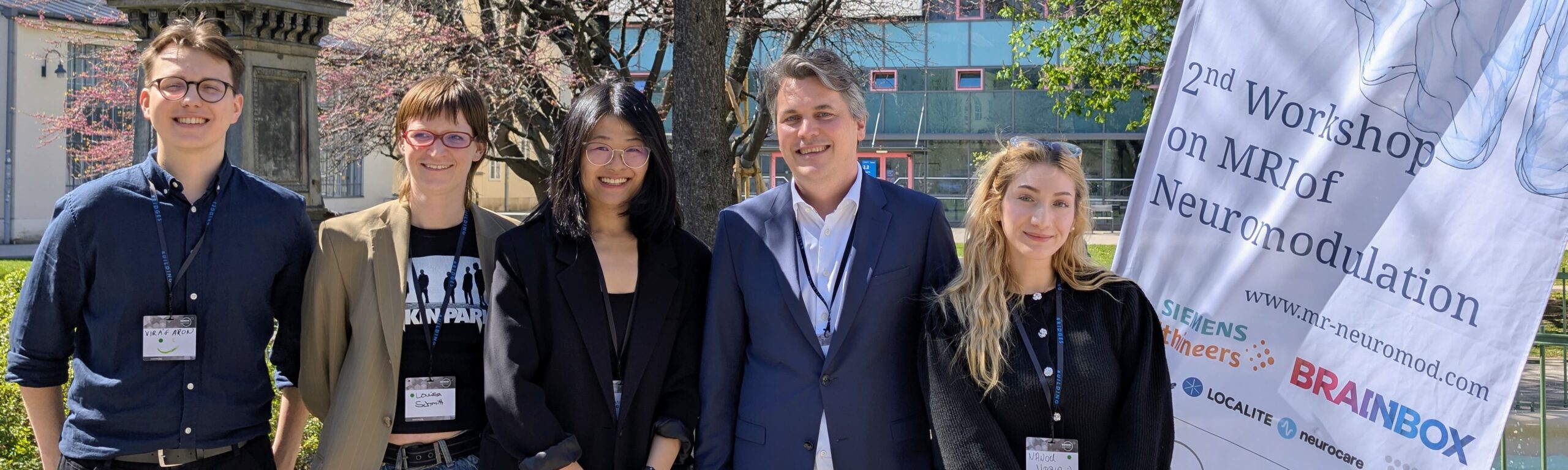
Different disciplines.
A shared scientific question.
Meet the people developing and applying neuroimaging-informed brain stimulation.