Chronometric TMS-fMRI tests how the timing of a perturbation changes a brain network’s response.
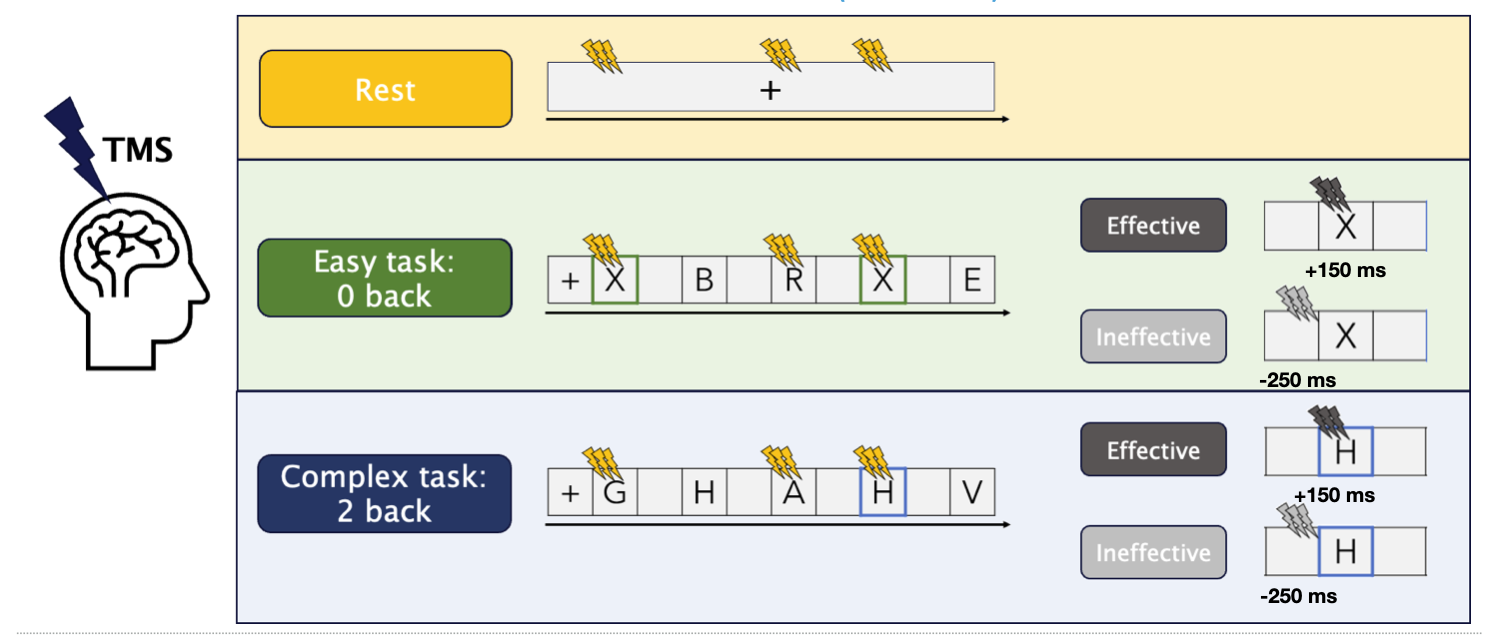
We apply TMS at defined moments relative to a task event, then compare the resulting local and remote BOLD responses. Keeping the target and stimulation parameters controlled lets us ask how cognitive context changes network susceptibility.
Working memory and language
Our working-memory studies use N-back tasks to establish reproducible cognitive states. In language experiments, stimulation at different moments during picture naming probes the changing contribution of temporal and frontal regions.
Watch the original EPICONN animation · 42 seconds
Precise perturbation, haemodynamic readout
Chronometry does not turn fMRI into a millisecond recording of neural activity. The precise variable is when we stimulate; the measured outcome is the subsequent BOLD response. We interpret timing effects through controlled comparisons and behavioural measures.
Chronometric TMS-fMRI and state-dependent sgACC effects, 2024 ↗
Chronometric interleaved TMS-fMRI of speech production ↗
Task state and stimulation timing
Chronometric TMS-fMRI in Vienna
Meet Martin Tik and the research team developing these methods at MedUni Vienna. Explore related language research, EPICONN and publications.
Student projects, research interests and collaborations in Vienna →