Behaviour tells us when stimulation changes performance. Imaging helps us investigate what happened across the network.
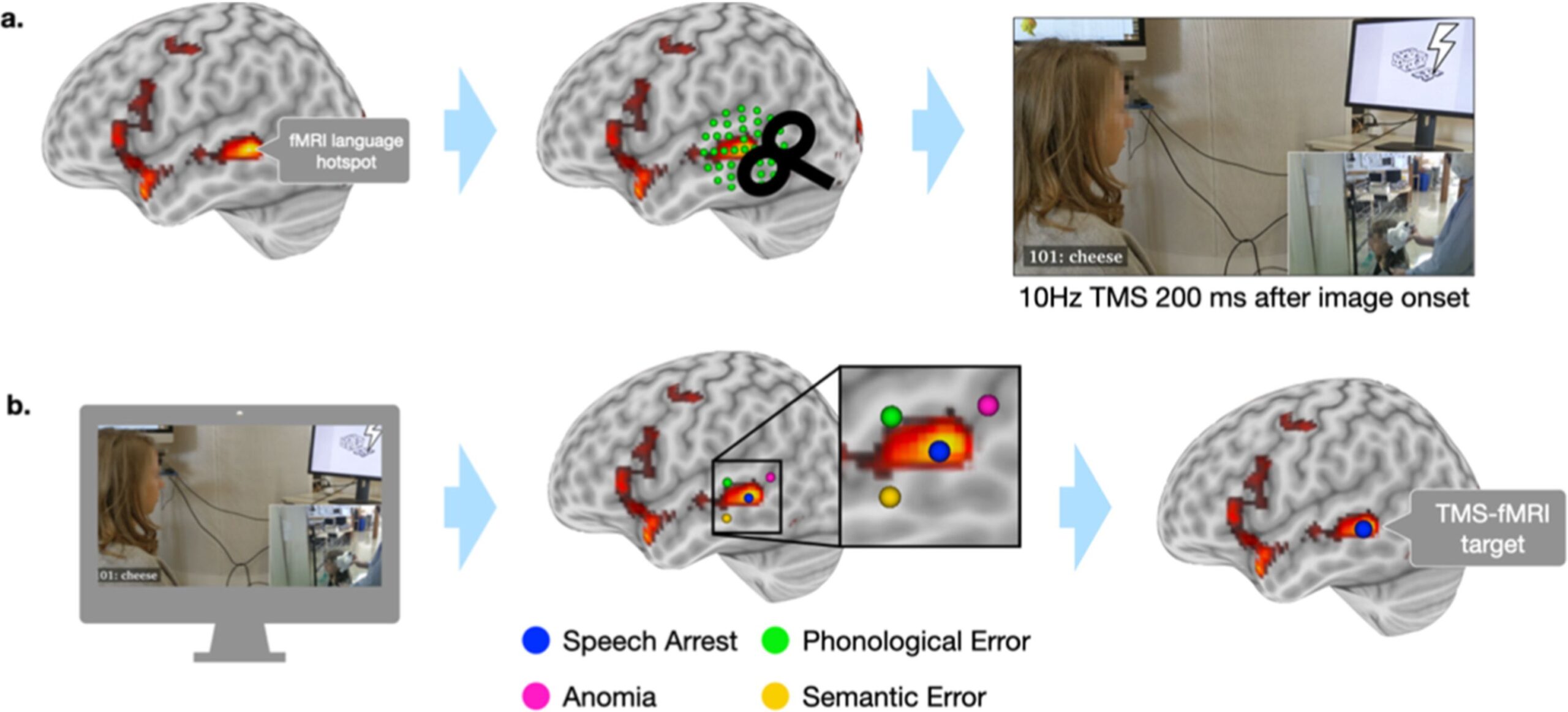
We combine neuronavigated language mapping, individual connectivity and chronometric interleaved TMS-fMRI. Picture-naming experiments let us compare stimulation sites and timings while measuring responses beyond the stimulated cortex.
Testing network hypotheses
Our research links posterior temporal stimulation sites to different language effects and examines how task timing changes remote responses. This helps move beyond a simple account in which a naming error is attributed only to a local disruption.
Working-memory experiments provide a complementary way to study state-dependent engagement of prefrontal networks. Together, these approaches form a methodological foundation for our contribution to EPICONN.
From language localisation to perturbation
Spoken and signed language
Verena Witz’s DOC fellowship project investigates language processing in Austrian Sign Language (ÖGS) and German using fMRI and TMS. This expands our work on how language is organised across different modalities.
Shared work: location, connectivity and timing
Our language programme brings together Maria Vasileiadi, Anna-Lisa Schuler, Michael Woletz, Verena Witz and other collaborators. The 2023 study combined separate fMRI and neuronavigated TMS measurements to interpret spatial differences in language mapping. The later chronometric study tested timing-dependent network responses during object naming, with John Coetzee at Stanford among its coauthors.
Functional connectivity explains how neuronavigated TMS of posterior temporal subregions differentially affect language processing
Vasileiadi M et al.
Connectivity and electric-field modelling help interpret the naming effects of stimulation at nearby temporal targets.
Chronometric interleaved TMS-fMRI shows state-dependent network effects underlying speech production
Vasileiadi M, Schuler AL, Woletz M, Witz V, Grosshagauer S, Coetzee J, Tik M.
Different stimulation times during object naming produce different network responses. Published online in December 2025; 2026 journal volume.